Fission: Building the Liquidity Layer for Tokenized Funds
Today’s Market Limitations
The liquidity problem in private markets predates tokenization.
Today, more than $600 billion is invested in semi-liquid fund products: BDCs, interval funds, and tender-offer funds. These structures were designed to give investors access to private and less-liquid assets while offering some degree of periodic liquidity. This liquidity has remained constrained by the fundamental mismatch between when investors want capital back and when the underlying assets can efficiently return it.
Most of these products offer liquidity through periodic repurchase or tender programs rather than continuous secondary markets. Recent redemption activity has made that mismatch increasingly visible. Today there are approximately $48 billion1 of redemption requests in excess of available periodic liquidity.
Redemption limits are only one part of the problem. The underlying operational infrastructure adds another layer of friction.
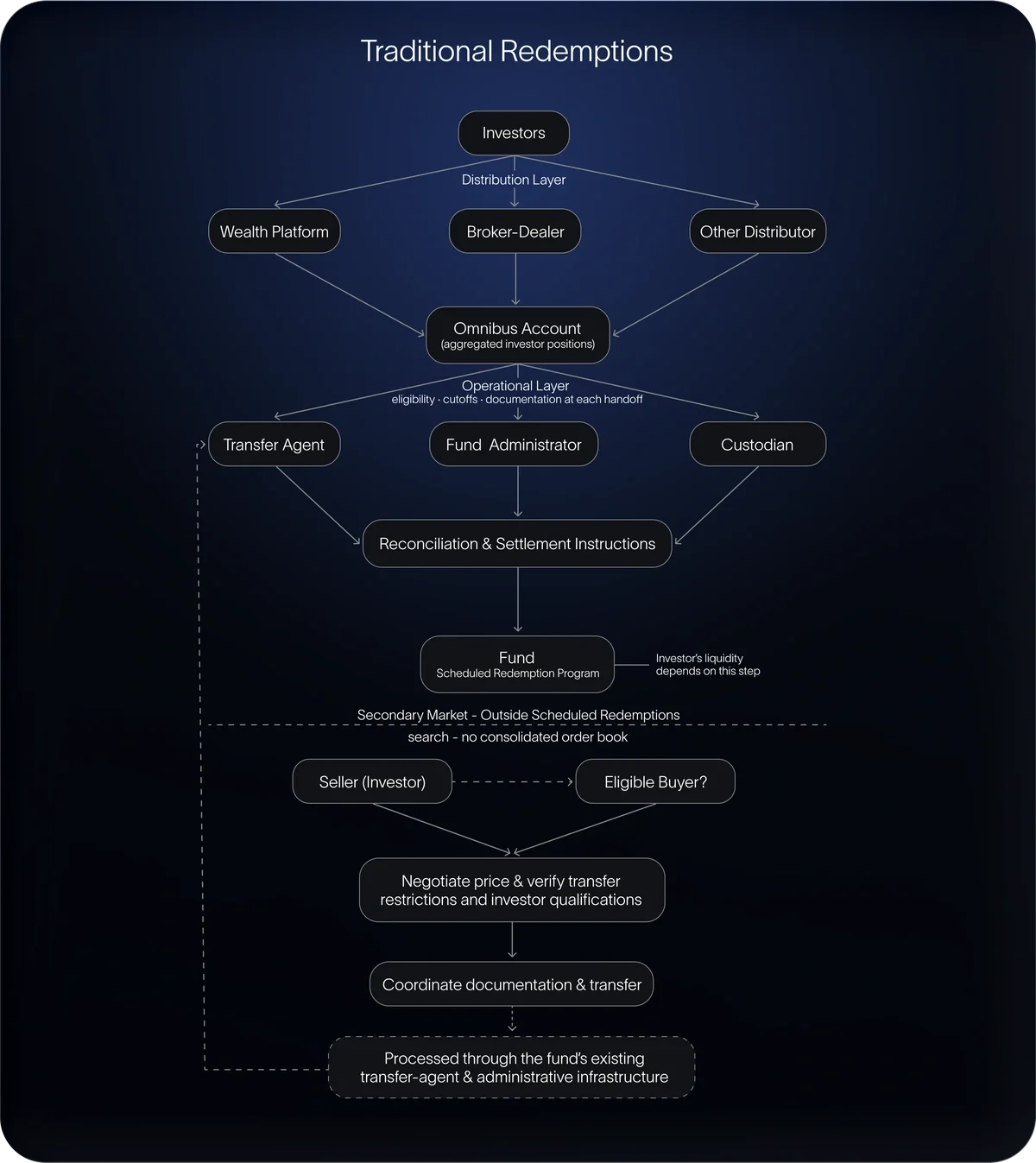
An investor may access a private-market fund through a wealth platform, broker-dealer, RIA, or other distributor. Those intermediaries frequently aggregate investor positions through omnibus accounts that connect to transfer agents, administrators, custodians, and ultimately the fund itself.
A redemption request therefore does not simply travel from investor to fund. It moves through multiple operational layers, each with its own eligibility requirements, cutoffs, documentation, reconciliation, and settlement processes.
The secondary market is even more fragmented. Outside a fund’s scheduled redemption program, liquidity in private and semi-liquid funds typically depends on bilateral or OTC transactions. A seller must find an eligible buyer, negotiate pricing, verify transfer restrictions and investor qualifications, coordinate documentation, and ultimately process the transfer through the fund’s existing transfer-agent and administrative infrastructure.
There is no consolidated order book or standardized settlement process and liquidity is largely dependent on finding an eligible buyer at the right time.
Tokenization can materially improve ownership, transfer, and settlement. It does not solve the question of who is willing to buy the asset when an investor wants liquidity. Tokenization allows investors to take custody of securities at any hour but it does not allow those positions to be converted back to cash just as quickly. This is a structural limitation that becomes increasingly more visible as tokenization expands beyond liquid government securities and bonds. Tokenized rails limit investor friction but technology itself cannot eliminate duration from the asset.
Ultimately, every liquid market depends on someone being willing to stand between the investor who wants liquidity today and the asset that naturally returns capital later.
A New Asset Class Is Moving Onchain
These structural gaps become more important as the quality and complexity of the assets moving onchain increases.
The market has already progressed from tokenized cash and Treasury products into investment-grade credit, high-yield strategies, CLOs, private credit, and alternative investment funds. Over time, the same infrastructure can support private equity, secondaries, real estate, and other longer-duration strategies.
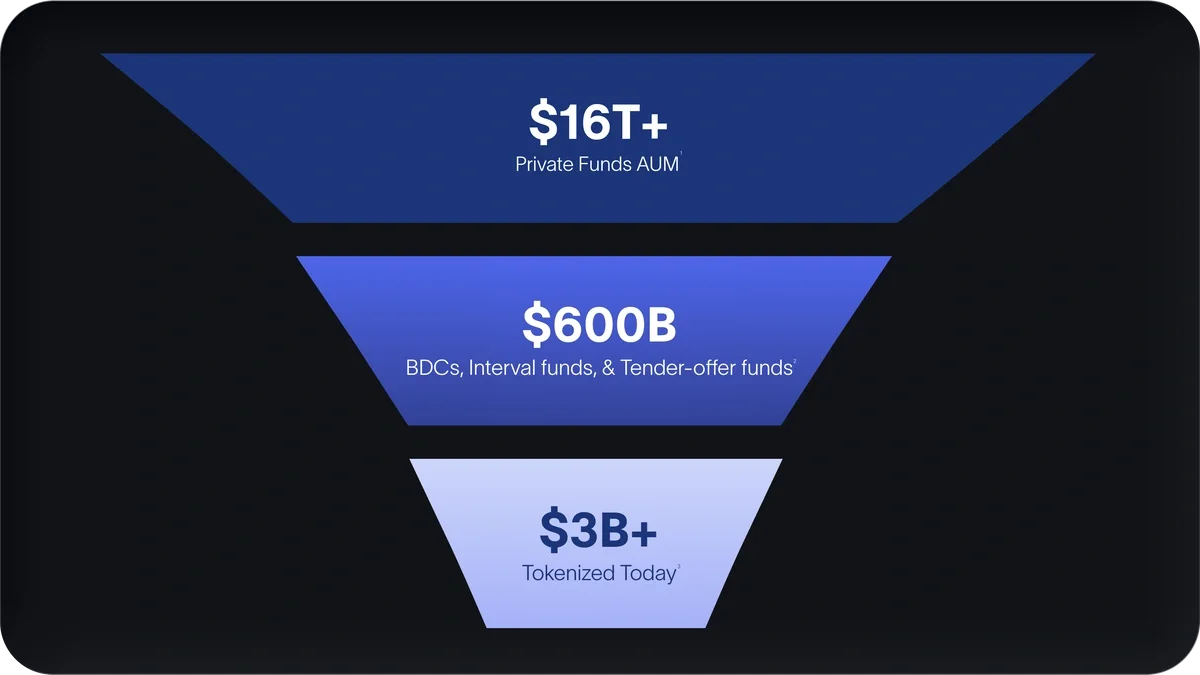
McKinsey & Company, Global Private Markets Report 2026 (traditional closed-end commingled AUM, 2025), Robert A. Stanger & Co., Q2 2026 closed-end fund report, Fission analysis of RWA.xyz data
As that asset mix expands, scalable liquidity becomes harder to source. Longer duration assets require more intermediation, not less.
This is the natural evolution of a new financial market. As asset classes become more broadly distributed, intermediaries emerge to price liquidity and warehouse the timing mismatch between buyers and sellers. Public markets developed market makers. ETFs developed Authorized Participants. Credit markets developed dealers and warehousing facilities. Tokenized private markets require the same economic function, rebuilt for assets that settle and move between blockchains.
Treasury funds are comparatively straightforward to integrate into digital markets because their underlying assets are liquid, their pricing is transparent, and their redemption cycles are short. Private markets work differently and require new infrastructure to preserve capital efficiency and limit counterparty risk. Investor liquidity should not need to match the fund's redemption schedule.
Introducing Fission
Fission provides atomic USDC liquidity for tokenized institutional assets while managing the underlying redemption and settlement process behind the scenes.
For the investor, the process is straightforward.
A registered investor holding a supported tokenized asset can exchange that position for atomic USDC liquidity. Fission acquires the fund position, delivers stablecoins to the investor, and assumes ownership of the asset until it is redeemed.
The investor receives liquidity immediately. The underlying fund continues to settle according to its existing terms. Fission allows asset managers to keep managing assets the way they know how, while giving onchain markets the liquidity characteristics they have come to expect.
Institutional investment products should not be redesigned around instant redemption. This introduces unnecessary costs, constrains portfolio construction, and alters the investment strategy itself. Instead, Fission changes the infrastructure around the asset, sitting between the investor’s demand for immediate liquidity and the fund’s natural liquidity cycle.
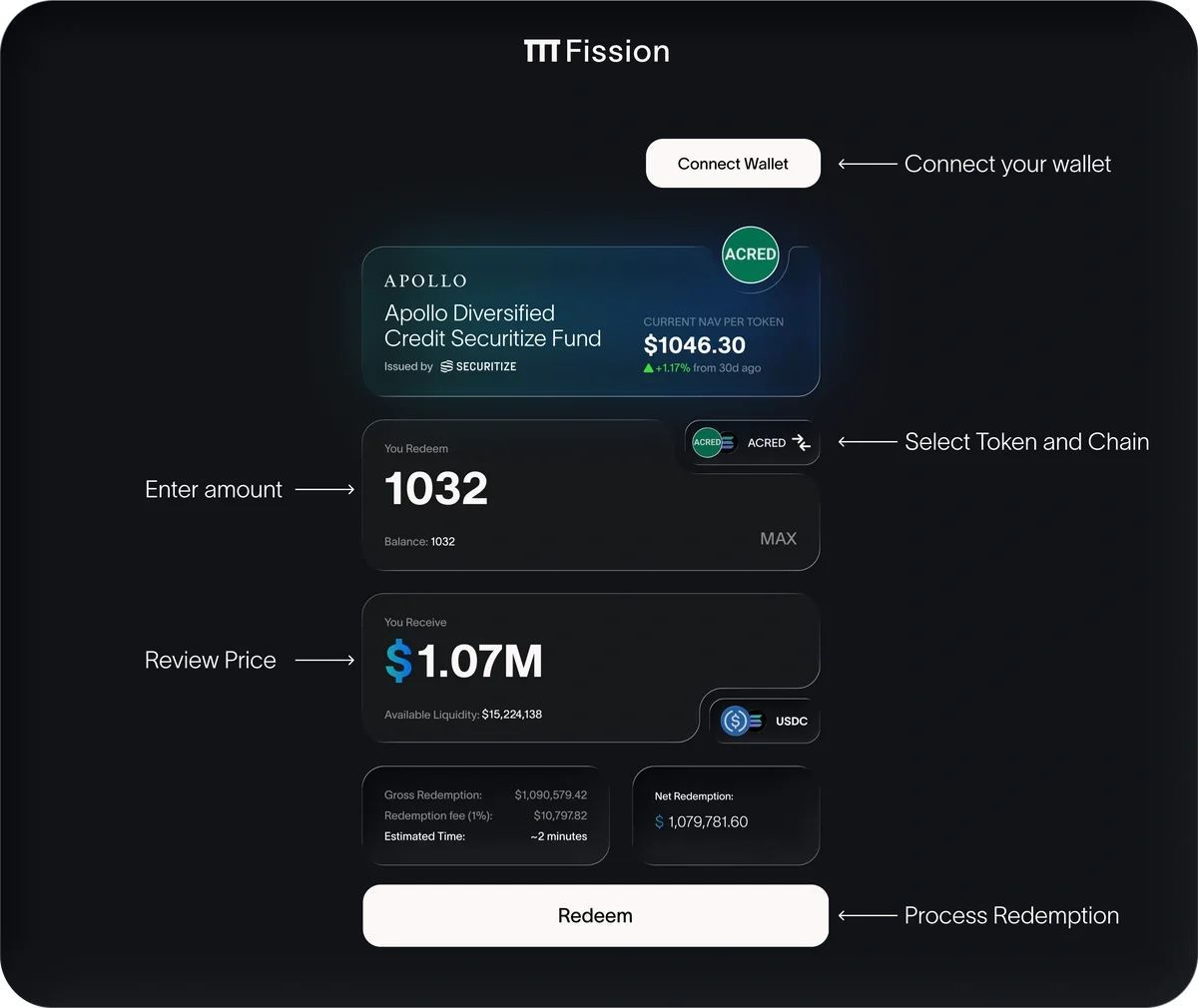
When the underlying capital is returned, proceeds are recycled and made available for future transactions.
Behind this simple investor experience is a capital-allocation and risk-management system built specifically for tokenized institutional assets. Fission manages liquidity across a diversified portfolio rather than treating each asset as an isolated pool. Exposure limits, expected duration, financing availability, asset quality, redemption characteristics, concentration, and market conditions collectively determine how much capital can be deployed against any individual position.
Transactions settle through audited smart contracts and institutional custody infrastructure, including Fireblocks, allowing tokenized assets and stablecoins to move atomically and, where supported, across networks.
Fission’s product combines onchain and offchain sources of capital, financing, and balance-sheet capacity. Capital can therefore be deployed where it is most economically efficient and recycled as underlying positions settle.
The point isn't just liquidity; it's liquidity that scales without requiring equivalent amounts of capital to sit idle against each asset.
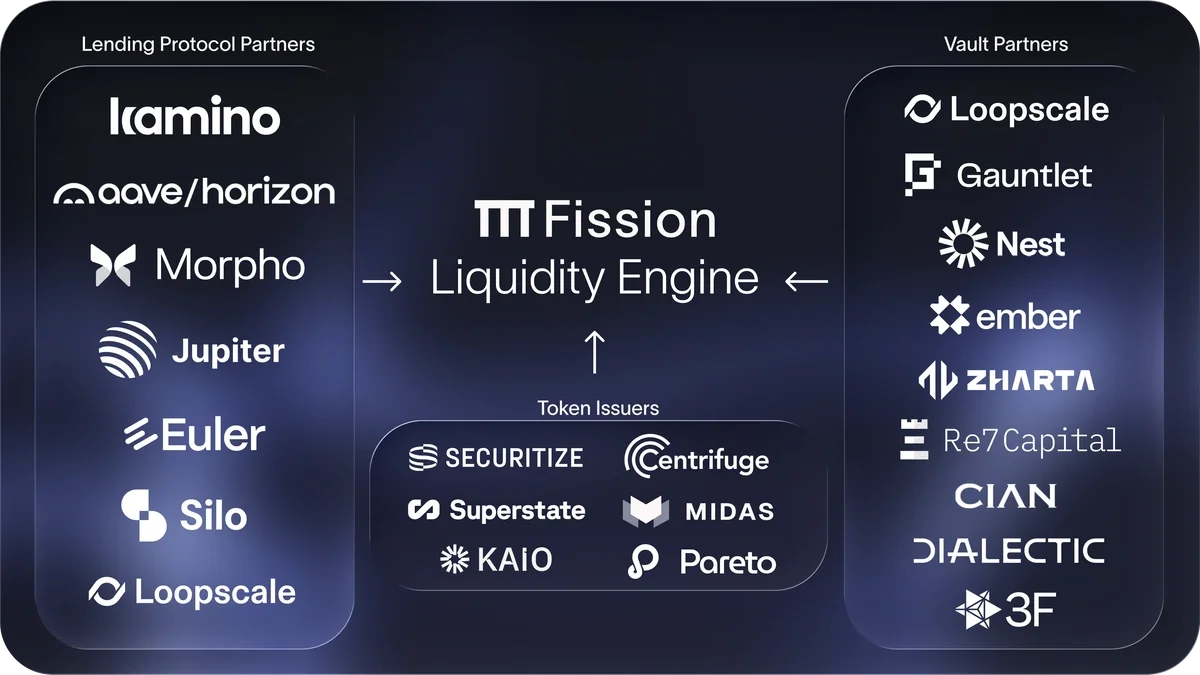
The Fission Ecosystem
Liquidity Is What Turns Assets Into Markets
Instant liquidity is the first use case. The broader value is what dependable liquidity makes possible.
Better Collateral
Lending markets can underwrite tokenized assets differently when there is a credible mechanism for converting collateral into stablecoin liquidity following a default.
More Efficient Trading Inventory
Market makers can intermediate positions without necessarily committing balance sheet for the entire duration of the underlying fund’s redemption cycle.
More Useful Treasury Assets
Institutions can allocate capital to higher-yielding strategies while preserving access to working capital.
Building Market Structure, Not Another Tokenized Product
Fission is not dependent on one manager, one network, or one specific product winning this market. Our role is to underwrite liquidity across different issuers, asset classes, redemption profiles and networks. As more institutional products move onchain, this common liquidity layer becomes more useful.
Asset managers should not have to redesign successful products around limitations of today’s DeFi markets. Those markets should evolve to enhance the products institutions already own in paper format.
New Markets Create New Products
The most important consequence of better liquidity may ultimately be the products that become possible because of it. Private markets have historically been distributed as individual funds with distinct subscription processes, administrators, reporting cycles, redemption mechanics, and liquidity constraints. Tokenization standardizes the infrastructure around issuance and ownership.
If investors can move efficiently between tokenized private credit, alternatives, secondaries, and eventually private-equity exposures, those investments can begin to operate as components of a broader digital private-market ecosystem rather than as isolated funds. This creates a future where diversified private-market portfolios can be constructed across managers, asset classes, and liquidity profiles while keeping the underlying funds the same. Private market ETFs.
The Next Phase of Tokenization
Tokenization is here to stay. Phase One brought institutional assets onchain; Phase Two will focus on making these assets easier to finance, trade and use as collateral once digitally native. This requires liquidity, financing, interoperability, risk management, and market structure built around how institutional assets actually work.
Fission is building the liquidity infrastructure that enables this market to grow.
Explore live supported markets at fission.xyz.